
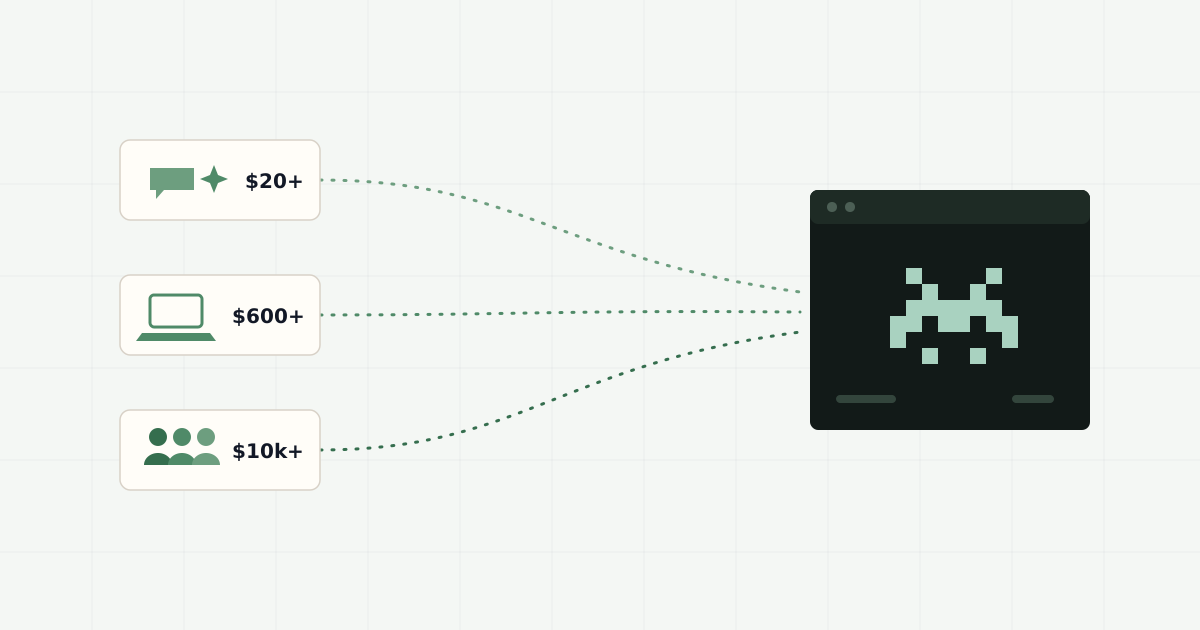
A simple browser game in 2026 costs from $20 if you build it yourself with an AI assistant, from $600 with a freelancer, and from $10,000 at a studio. The three-orders-of-magnitude spread has a simple explanation: you are not paying for the game, you are paying for how much of other people's time and responsibility you buy.
Games made all three ways pass through GameFoundry every week, and the downloads show that the production method barely affects success with players. It affects timelines, nerves and budget a lot. I'll walk through all three paths with numbers, and finish with the costs people remember only after release.
Path one: yourself plus an AI assistant
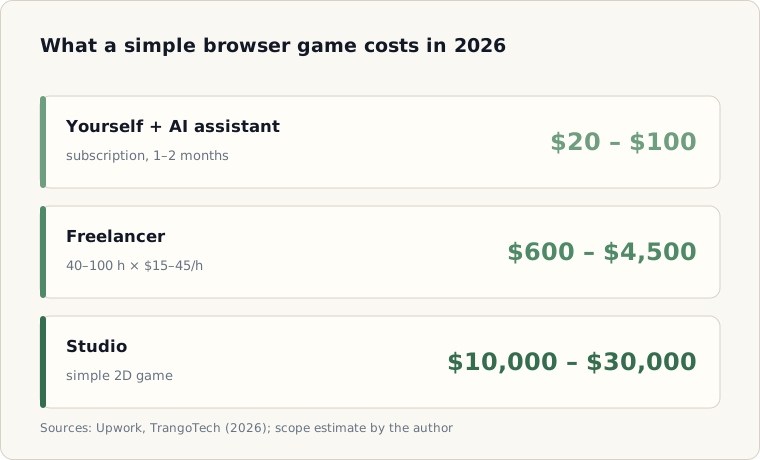
The minimum budget is an AI assistant subscription, about $20 a month. A browser game needs no engine and no servers: one HTML file that you assemble by talking to a neural network. I covered how this works in practice in my article on AI-created games; the short version is that an arcade game or a puzzle comes together over a few evenings with no programming background.
The hidden price of this path is your time. First games eat 20 to 40 hours, and most of it goes into reworks rather than code: the mechanic is boring, the controls feel sticky, the difficulty jumps around. In money it's almost free. In time it's the most expensive option of the three.
It makes sense when the game is your idea and your hobby, and every editing cycle brings you joy instead of irritation.
Path two: a freelancer
The median rate for an HTML5 developer on Upwork is $22 an hour, with a typical range of $15 to $30; full-stack specialists start at $45. A simple browser game takes an experienced person 40 to 100 hours, so the realistic budget is $600 to $4,500. Eastern Europe and Asia are cheaper, North America is several times more expensive.
The main risk here is the brief. A freelancer will build exactly what the spec says. If it says "a game like Flappy Bird," you will get a game like Flappy Bird, and every "could we also add..." becomes a new invoice. My advice from running the platform: first assemble a rough but playable prototype yourself with AI, put it in front of real players, and only then bring it to a freelancer for polish. That way you pay to refine an idea that already works.
Path three: a studio
According to TrangoTech's 2026 guide, a simple 2D game at a studio costs $10,000 to $30,000, a mid-sized one up to $70,000, and team rates range from $20–45 an hour in Asia to $80–150 in North America. For that money you buy a process: art, sound, testing, a manager who owns the deadline, and a team that won't vanish mid-project.
A studio makes sense when a business depends on the game: a branded promo game, a game inside your product, a Telegram Mini App built to earn. As an example from exactly this niche, London-based ICE WIND builds browser games and Telegram Mini Apps alongside websites and bots with one team, without handing the project between vendors. Their motto, "Cold heads. Warm delivery," is a fair summary of what studios are actually paid for: a sober estimate before the start, and a result that reaches production.
Whatever you choose, ask the contractor four questions before any prepayment:
- Who owns the code and source files after payment? The answer should be "you," in writing.
- What does the price include: just the build, or device testing, sound and post-release fixes?
- How is work beyond the spec billed, and what does an hour of such changes cost?
- Can you see a similar project that real users are playing right now?
Clear answers to these four questions filter out most problem contractors, freelancers and studios alike.
The costs people remember after release
Development is not the whole budget. A domain and hosting run $20 to $100 a year, though a browser game on GameFoundry needs no hosting at all. Paid art and sound packs add another $20 to $200 if you don't draw your own. Test devices, at least one old Android phone, save you from post-release surprises. And above all: marketing. A game without players costs the same as a game that doesn't exist.
The cheap way to find out whether anyone besides you needs your game is to put it where players and feedback already are. On our platform uploading is free, the game enters the weekly contest with a 100 USDT prize pool, and reviews and ratings show whether the idea deserves further investment.
FAQ
How much does the cheapest possible game cost?
About $20: one month of an AI assistant subscription, which is enough to build a browser game yourself. Free tiers let you try for zero, but they usually run out before a full game is done.
How much does it cost to order a simple browser game?
From a freelancer, $600 to $4,500 at rates of $15–45 an hour and a scope of 40–100 hours. From a studio, upwards of $10,000, but with art, testing and someone accountable for the deadline.
Why are studios so much more expensive than freelancers?
You pay for a team and a process: a designer, a developer, a tester and a manager instead of one person. For a hobby project that's overkill. For a game a business depends on, it's insurance against failure.
Can I combine the approaches?
That's the most sensible scenario: build the prototype yourself with AI, test demand on free platforms, and bring money to a contractor only once the idea has proven alive. Every dollar then goes to something that already works.
Where can I save, and where shouldn't I?
Save on the engine (a browser game doesn't need one), on hosting and on stock assets. Don't save on testing with real people: controls that fail in the first thirty seconds kill a game more reliably than any bug.
Maksim Ilin is the founder of GameFoundry, a marketplace where indie games compete for weekly prizes decided by player votes. I write about game creation using examples from our own catalog.